


Types of Gold Chains: A Complete Guide to Every Chain Style
A gold chain can change the whole look before you add a pendant, watch, or another piece of jewelry. The difference often starts with something simple: the way the links are shaped and connected.
There are dozens of types of gold chains, from twisted Rope chains and flat Cuban links to tight Franco weaves, smooth Herringbones and bold RX styles. Each one catches light differently, sits differently on the body and brings its own character to a fit. Width, length and construction can change the look even more.
This guide breaks down the major gold chain styles so you can see what actually separates them and decide what works for you. These are the kinds of chains customers compare at Candy Jewelers' Slauson Supermall showroom in Los Angeles and across the brand's real gold chain collection.
Key Takeaways
- The link pattern defines the style. Rope chains twist, Cuban links lie flatter, Franco chains create a dense squared weave, and Herringbone chains form a smooth ribbon-like surface.
- Cuban and Miami Cuban chains are different. Standard Cuban links are generally flatter with more visible spacing. Miami Cuban links are thicker, rounder and packed more tightly together.
- Some chains are better with pendants than others. Rope, Franco and Cuban-style chains are popular starting points, while flat styles such as Herringbone are usually better worn on their own.
- Hollow and solid describe construction, not whether the gold is real. Hollow chains use less metal inside the same general profile, which can create a bigger look at a lighter weight and more accessible price.
- There is no single most durable gold chain for everyone. Link design matters, but so do width, gram weight, construction, clasp and how the chain is worn.
- The best chain is the one that fits the look you want. A dainty Rope, wide Miami Cuban and flat Herringbone can all be the right choice. They simply do different jobs.
What Makes One Gold Chain Style Different From Another?
At first glance, two gold chains can have the same length and width but look completely different once you put them on. The reason is the link construction.
A gold chain style is defined by the shape of its links, the way those links connect, how tightly they sit together and how the finished chain moves against the body. Surface treatments such as diamond cutting can change the look even more.
That is why understanding the basic types of chains makes shopping easier. Instead of choosing by width alone, you can choose based on the look you want and how you plan to wear it.
Link Shape and Pattern
Some chains use one link repeated from end to end. Others use a repeating sequence.
A Cuban uses flattened interlocking links. A Figaro mixes shorter links with longer ones. A Rope uses smaller links arranged into a twisting spiral. A Franco creates a tight, compact weave.
Those patterns affect how much surface you see, how the chain reflects light and how much visual space it takes up across the neckline.
Flat vs. Rounded Profiles
Herringbone sits flat and close to the body. A Miami Cuban has a thicker, more rounded profile. Franco chains have a dense squared shape, while Rope chains have a rounded, textured surface.
That is why the same listed width can look very different from one style to another.
Width and Visual Weight
Width is measured in millimeters, but the number does not tell the whole story.
A 2mm Rope can create a clean everyday look with visible texture. A wider Cuban or RX puts far more focus on the necklace itself.
Profile, spacing and construction all affect how large a chain appears once it is worn.
Diamond-Cut vs. Smooth Finishes
Diamond cutting does not mean diamonds have been added.
Small facets are cut into the surface of the gold. Those flat areas reflect light from different angles, creating more flash than a completely smooth finish.
Diamond-cut Rope chains are a common example.
Flexible Links vs. Structured Chains
Some chains move freely because each link has room to shift. Others are built to hold a more controlled shape.
Rope, Cuban and Figaro chains have obvious link movement. Herringbone and Omega styles behave more like flexible bands. RX chains use broader connected sections that create a structured watch-band look.
Neither approach is automatically better. It changes how the chain sits, layers and wears.

Gold Chain Styles at a Glance
|
Chain Style |
Visual Profile |
Best For |
Pendant Friendly? |
What to Know |
|
Rope |
Rounded, twisted and textured |
Solo, layering, pendants |
Yes |
Diamond-cut versions add extra flash |
|
Cuban |
Flatter interlocking links |
Solo, layering, pendants |
Yes |
More visible spacing than a Miami Cuban |
|
Miami Cuban |
Thick, rounded, tightly packed links |
Statement wear |
Yes |
Fuller profile and more visual weight |
|
Franco |
Tight squared weave |
Solo, pendants |
Yes |
Clean, dense construction |
|
Herringbone |
Flat ribbon-like surface |
Solo wear |
Usually no |
Protect from sharp folds |
|
Figaro |
Alternating short and long links |
Solo, layering, pendants |
Yes |
Pattern adds visual rhythm |
|
Valentino |
Decorative patterned links |
Solo, layering |
Depends |
More surface detail than basic links |
|
Box |
Square geometric links |
Pendants, layering |
Yes |
Clean supporting profile |
|
Rolo |
Rounded repeating links |
Pendants, charms |
Yes |
Simple and easy to pair |
|
RX / Presidential |
Wide watch-band-inspired profile |
Statement wear |
Usually solo |
Structured and instantly recognizable |
Rope Chains: The Twisted Classic
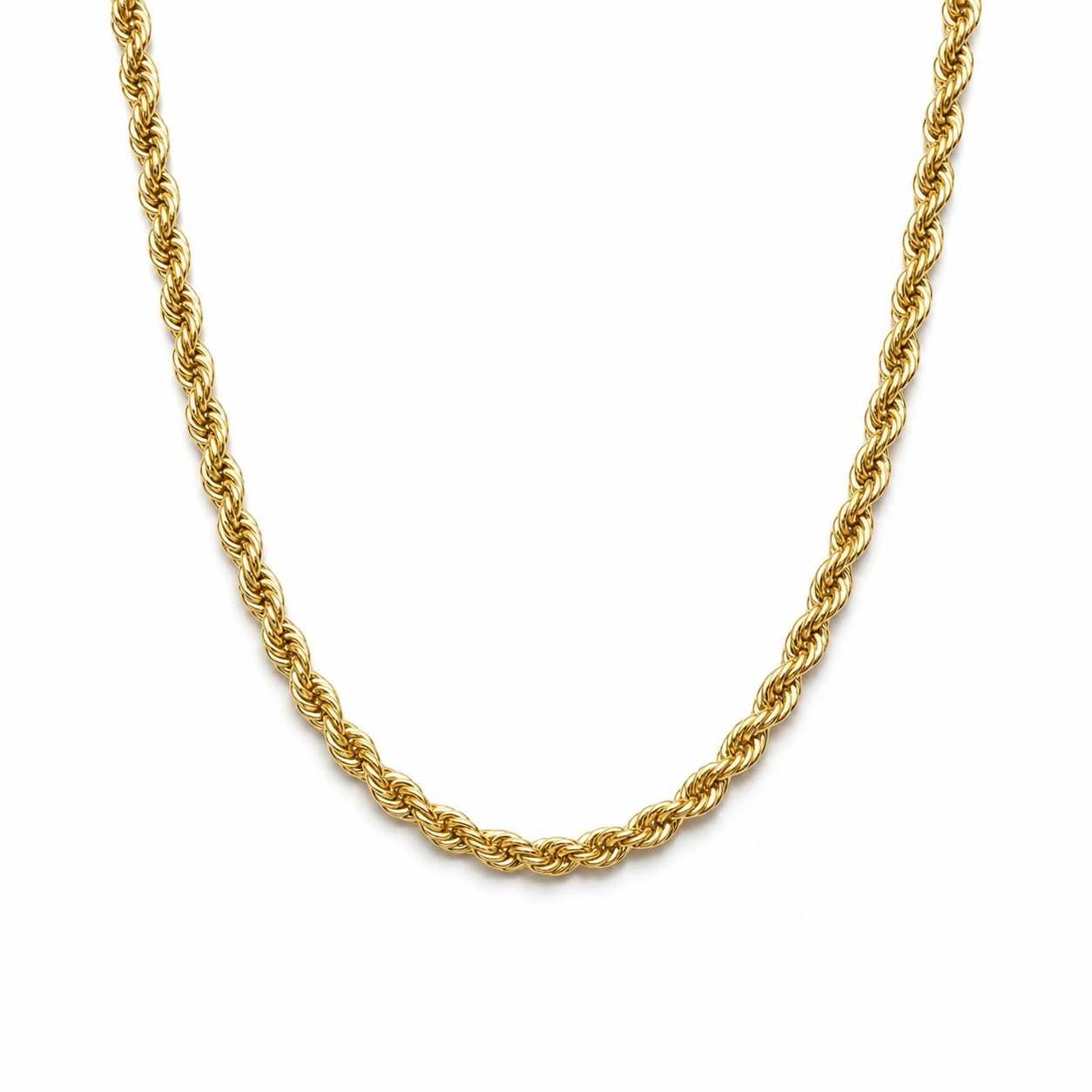
Few gold chain styles are as easy to recognize as a Rope chain. Small interlocking links are arranged into a spiral so the entire chain looks like strands of gold woven together.
That shape gives Rope chains their signature shine. Instead of reflecting light from one flat surface, the textured pattern catches it from different angles as the chain moves.
A Rope can be worn alone, layered with another link pattern or paired with a pendant. That versatility is a big reason the style has stayed relevant.
Standard Rope Chains
A standard Rope uses tightly arranged links to create one continuous spiral.
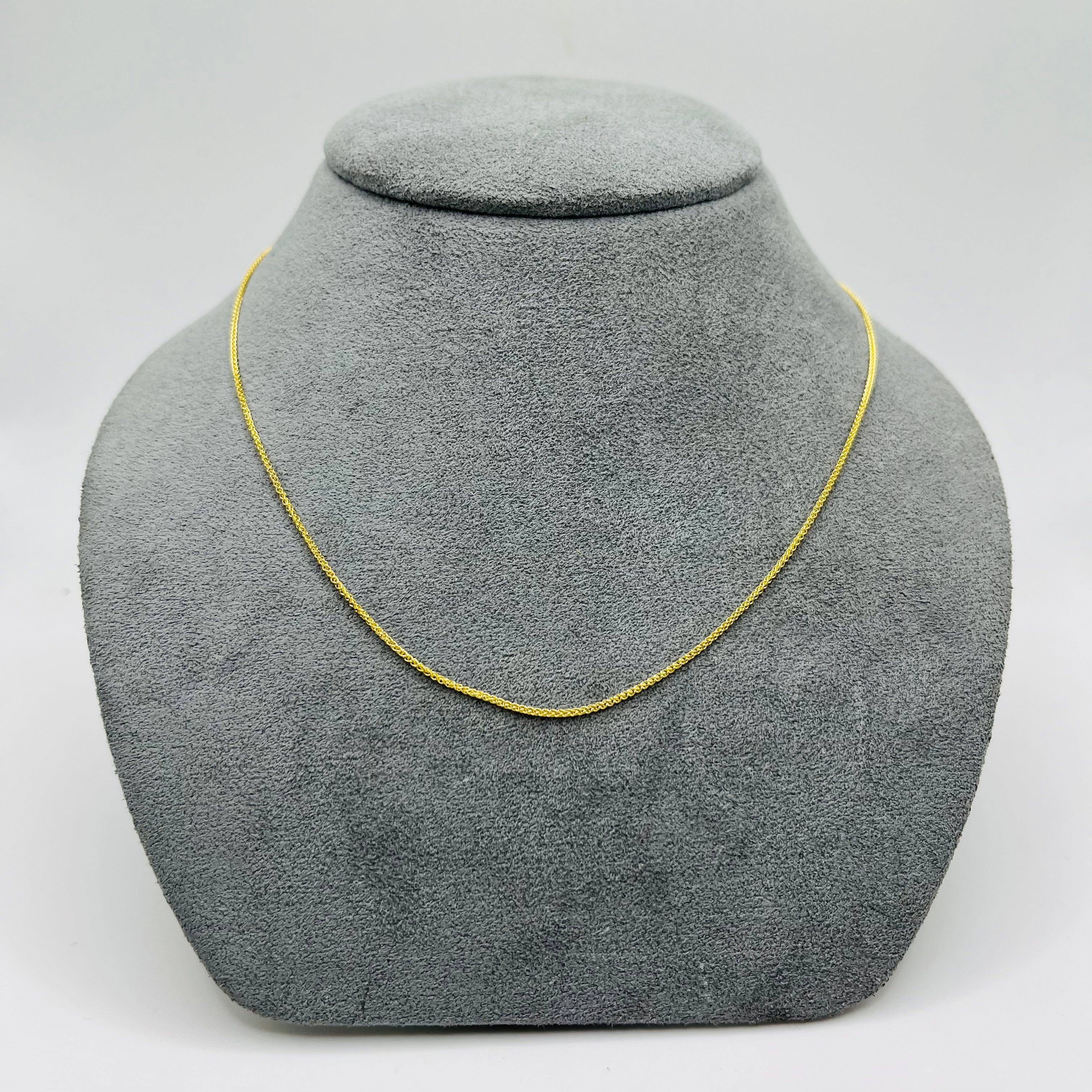
A thinner Rope works well when you want texture without a heavy visual presence. As the width increases, the same pattern becomes much more noticeable and can carry the neckline by itself.
Diamond-Cut Rope Chains
A diamond-cut Rope uses the same twisted construction with extra facets cut into the surface.
The result is a sharper flash, especially in direct light, photos and video. The chain gets more reflection without needing stones.
Hollow and Solid-Construction Rope Chains
A hollow Rope can still be real gold throughout the metal that forms its links. The difference is that there is less metal inside the structure.
That allows the chain to create a wider look while staying lighter on the neck and more accessible in price.
A solid-construction Rope contains more gold throughout the links. At a comparable width and length, it generally weighs more and costs more.
The tradeoff is care. Hollow Rope chains should be protected from crushing, hard pressure and strong pulls.
Rope chains are also more forgiving of normal twisting than flat styles such as Herringbone because their spiral shape is made to move.
That mix of texture, shine and flexibility is why the style works across solo wear, pendants and layered setups.
Candy Jewelers carries Rope chains in multiple widths and constructions, making this one of the easiest styles to compare at different scales.

Cuban Link Chains: The Everyday Heavyweight
The Cuban link is one of the most recognizable chain profiles. Interlocking links create a broad polished surface that sits close to the body and brings plenty of presence.
But there is an important distinction shoppers often miss:
A standard Cuban chain and a Miami Cuban chain are not the same style.
What Is a Standard Cuban or Curb Chain?
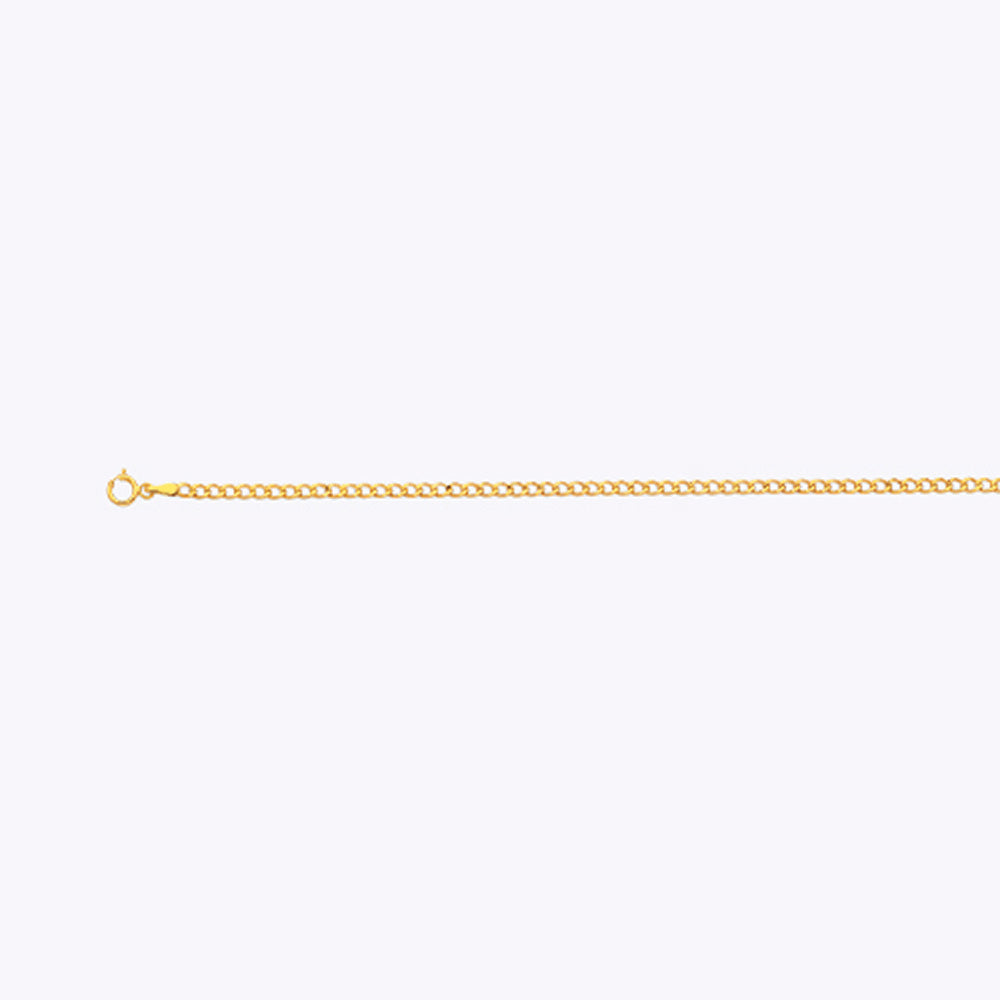
A standard Cuban uses interlocking links that are flattened so they lie in a consistent direction.
Compared with a Miami Cuban, you can generally see more space between the links. The flatter profile also gives it a lighter visual feel at comparable widths.
That makes a standard Cuban easy to style several ways. It can work alone, become part of a stack or support a pendant.
Within Candy Jewelers' chain terminology, curb and Cuban sit in the same flatter-link family. The most useful comparison is the actual profile, spacing, width and construction rather than the label alone.
What Makes a Miami Cuban Different?
A Miami Cuban pushes the profile in a much bigger direction.
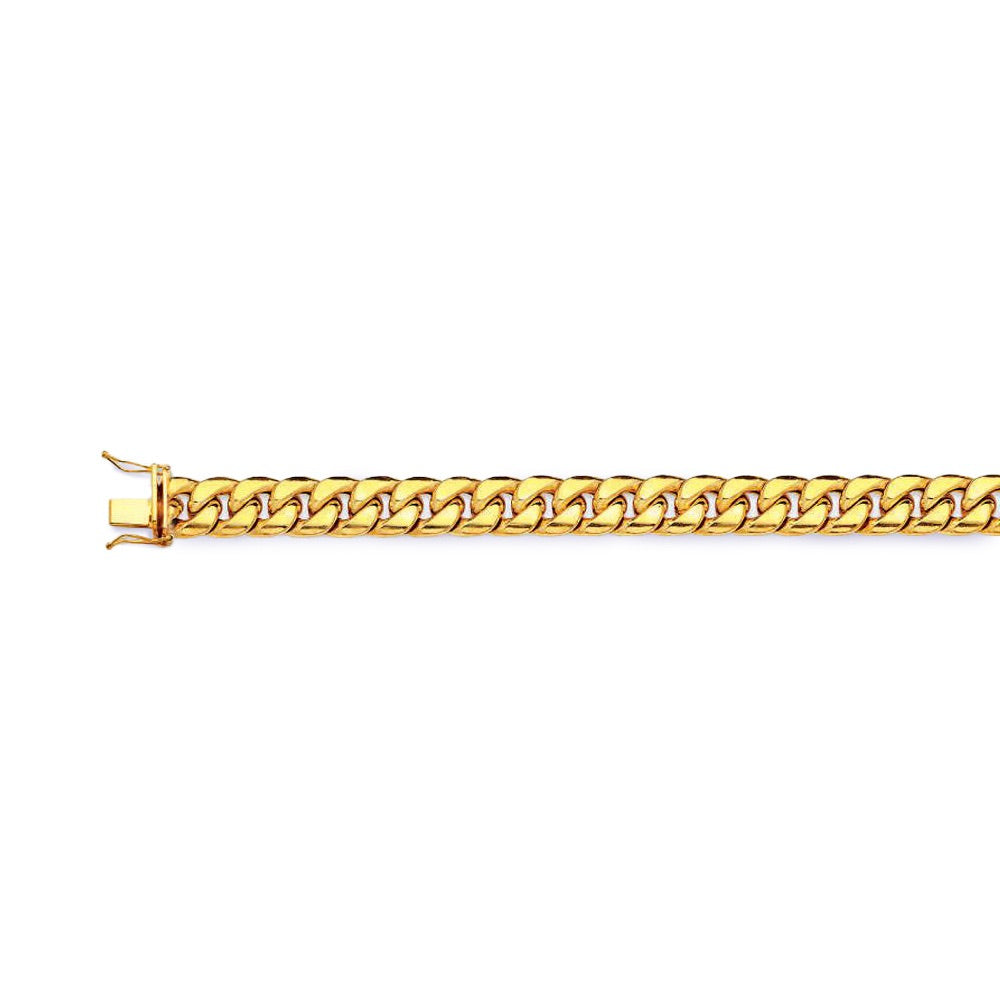
The links are thicker, rounder and set closer together. There is less open space, so the chain reads as a denser row of gold.
That is what gives the Miami Cuban its signature presence.
Wider versions are often enough to carry the entire neckline without another chain or pendant.
Miami Cubans can also use substantial box-style locks with added safety features, especially on heavier versions. That closure should not be assumed on every Cuban-style chain.
Candy Jewelers' Miami Cuban chain collection shows how different widths and constructions can change this profile.
Cuban vs. Miami Cuban at a Glance
|
Feature |
Standard Cuban |
Miami Cuban |
|
Link shape |
Flatter links |
Thicker, rounder links |
|
Spacing |
More visible space |
Tighter spacing |
|
Profile |
Lower and flatter |
Fuller and more dimensional |
|
Styling |
Versatile |
More statement-driven |
|
Layering |
Easy to mix |
Often leads the stack |
|
Pendants |
Works well in suitable widths |
More dependent on chain and pendant size |

Franco Chains: Tight, Square and Built to Last
A Franco chain looks completely different from an open-link Cuban or twisted Rope.
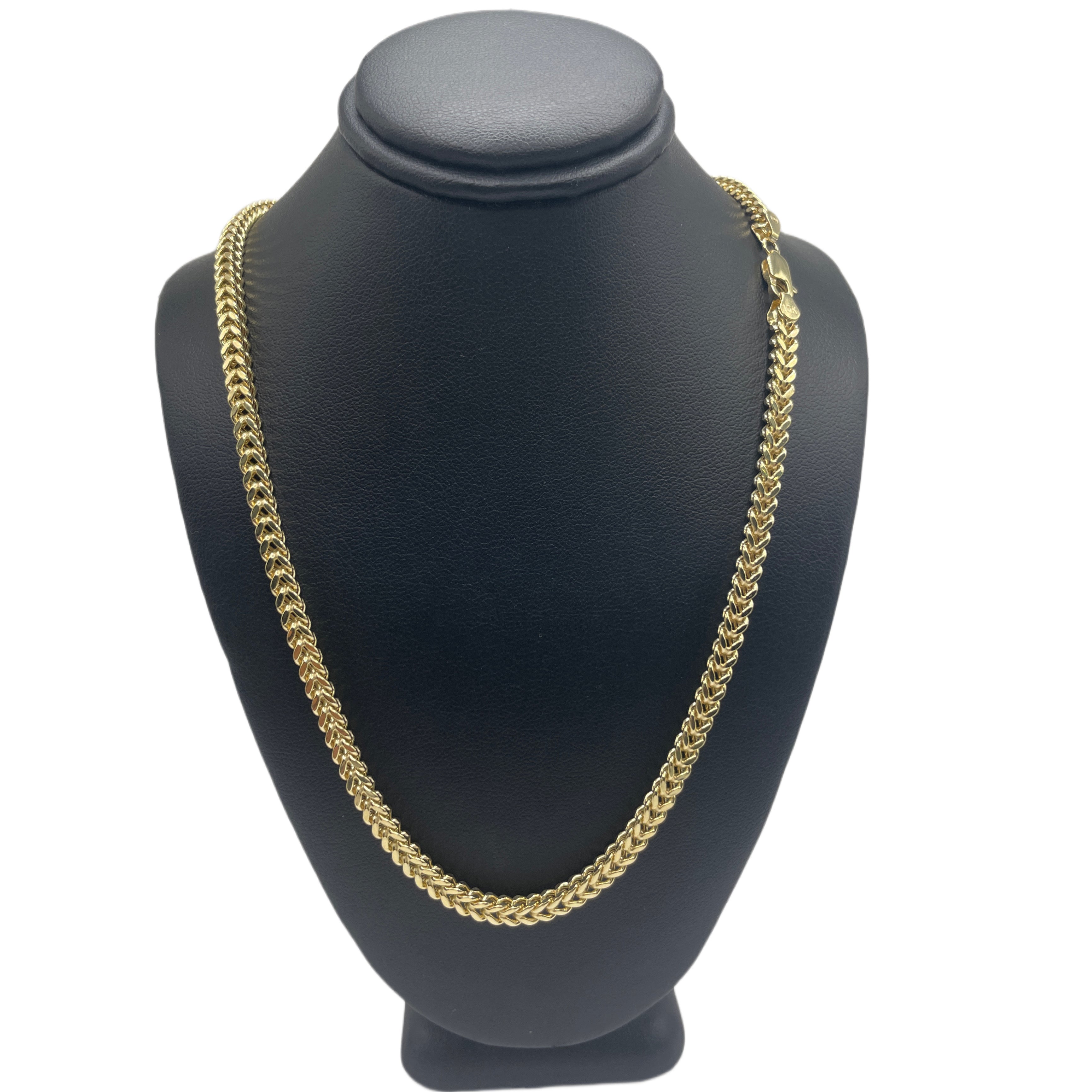
Its links interlock tightly to create a compact chain with a squared profile and a recognizable V-shaped pattern along the sides.
Instead of seeing every link from a distance, the Franco reads more like one continuous woven strand of gold.
Why Franco Chains Work With Pendants
Franco chains are one of the styles Candy Jewelers commonly recommends when a pendant is part of the plan.
The compact profile gives a pendant a clean base without introducing large spaces between the links. The squared shape also gives the chain visual weight from several angles.
Proportion still matters. A smaller pendant does not need the widest Franco available, while a larger piece may need more chain width and gram weight.
Franco chains also do not automatically come with the box locks associated with some large Miami Cubans. Closure style depends on the specific piece.
For someone who wants a structured chain that can work solo, layer cleanly and carry a pendant, Franco is one of the most flexible options.
See current Franco chain styles from Candy Jewelers.
Herringbone Chains: The Flat, Liquid Look
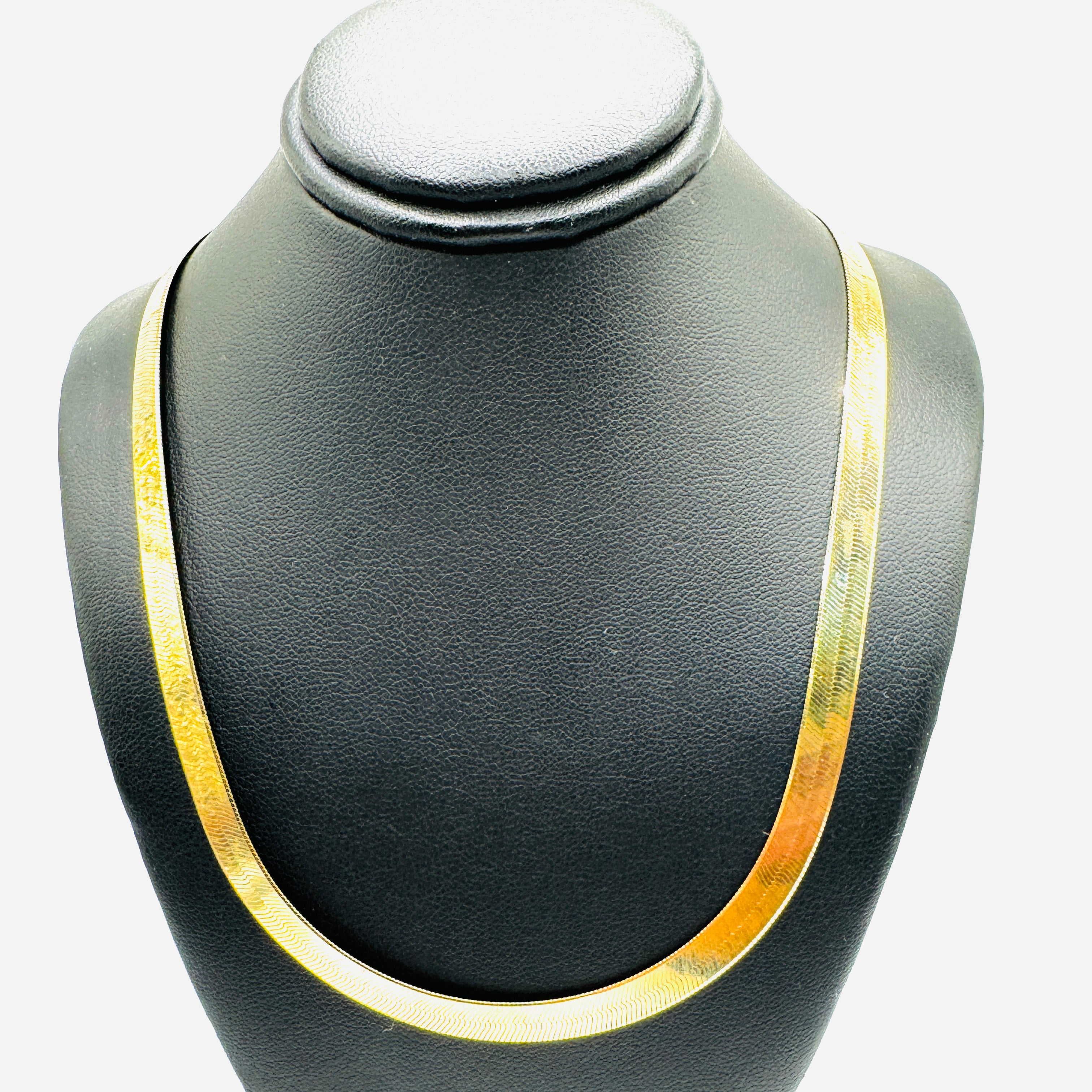
A Herringbone chain is built to lie flat.
Rows of closely connected V-shaped pieces create a smooth ribbon-like surface. When the chain moves, light travels across that broad face instead of bouncing between open links.
That is the main reason people choose Herringbone. The shape itself is the focal point.
Why Herringbone Is Usually Worn Solo
Herringbone is generally better without a pendant.
A pendant concentrates weight in one spot and can interfere with the flat structure. It also covers the feature that makes Herringbone different in the first place.
If the chain itself is supposed to be the statement, Herringbone makes much more sense.
Why Herringbone Needs Different Care
That smooth profile comes with a tradeoff.
Herringbone chains are made to curve gradually around the neck. They are not designed to be folded sharply.
If the chain gets pinched, crushed or folded back on itself, the flat links can kink and stop lying evenly. Jewelers of America also identifies Herringbone as a style more prone to twisting and kinking because of its overlapping structure.
Store it flat or loosely curved and remove it before activities where it may get trapped or folded.
Candy Jewelers' Herringbone chain collection shows the style across several widths.
Figaro and Valentino Chains: Patterned Links
Not every gold chain relies on one identical link repeated from end to end.
Figaro and Valentino chains stand out because the pattern itself becomes part of the design.
Figaro Chains
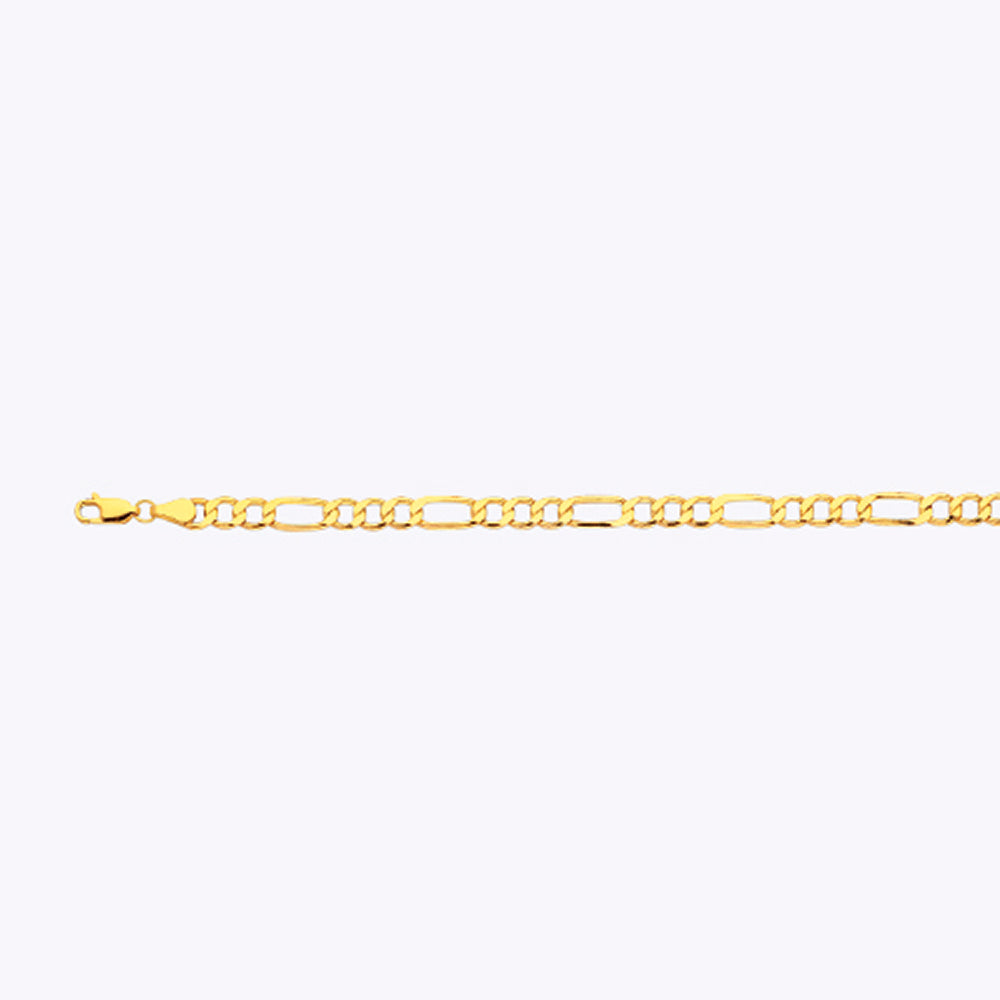
A Figaro chain uses a repeating sequence of shorter links followed by one longer link.
That rhythm makes the pattern easy to recognize. The links usually sit relatively flat, making Figaro useful for solo wear, layering and many pendant setups.
A slimmer Figaro feels cleaner and lighter. A wider one makes the alternating pattern much more noticeable.
Valentino Chains
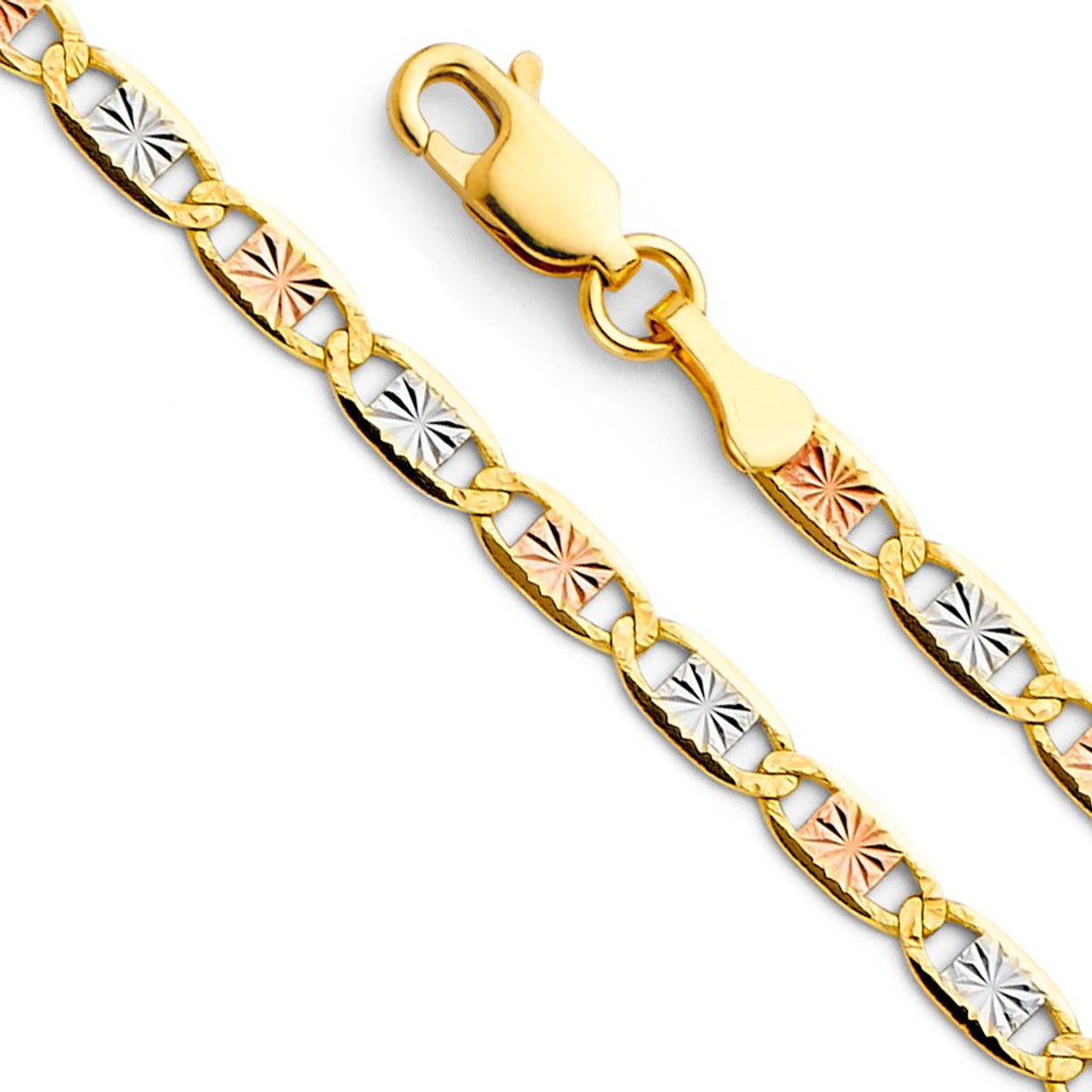
A Valentino chain takes patterned-link styling in a more decorative direction.
Instead of relying only on alternating link lengths, Valentino designs use broader polished links with additional geometric detail.
That creates more reflection without needing the thick profile of a Miami Cuban or RX chain.
Finer Valentino chains can work naturally in a layered setup. Wider versions often look better with the patterned surface left visible.
RX and Presidential Style Chains: Where They Came From
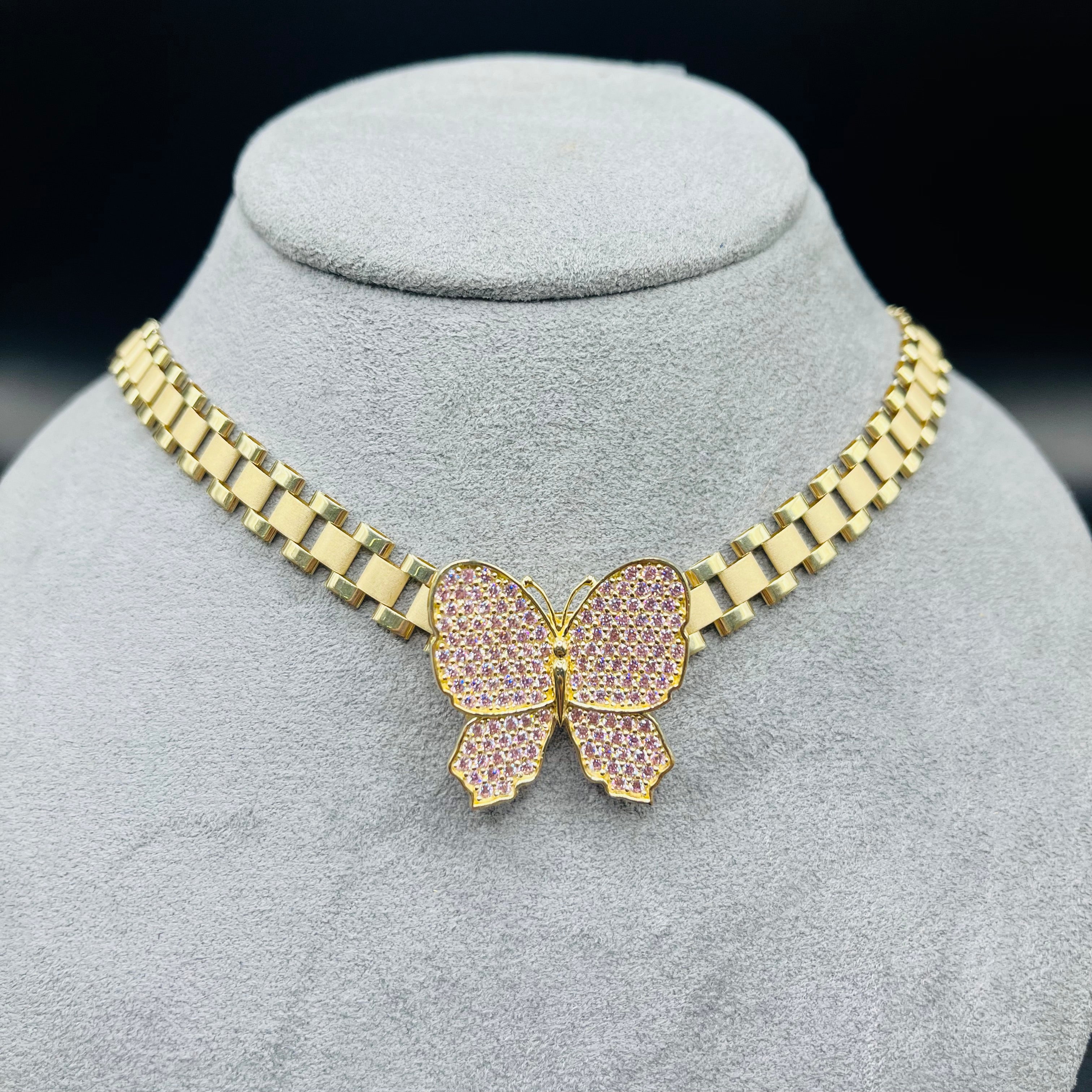
An RX chain, also called a Presidential-style chain in some jewelry settings, stands apart because its design takes cues from a watch bracelet rather than a basic round or oval necklace link.
The broad connected sections create a structured surface with much less open space than a Figaro or Cuban.
Why Is It Called a Presidential Style?
The name comes from watch design.
Rolex documents its President bracelet as a three-piece bracelet with semi-circular links introduced with the Day-Date in 1956.
Jewelry makers later adapted that recognizable visual language into necklace and bracelet styles.
An RX necklace should therefore be described as inspired by the watch-bracelet profile, not as a necklace created by Rolex.
What Does an RX Chain Look Like?
Compared with a Cuban, an RX has less obvious oval-link spacing.
Compared with a Franco, the RX looks flatter and broader.
That makes it especially strong as a standalone chain. The link pattern already gives the necklace a focal point.
RX also has particular relevance to West Coast jewelry styling and is a real differentiator in Candy Jewelers' assortment.
Browse the RX chain collection to see how much the look changes as width increases.
Box, Rolo and Fine Chains Built for Pendants
Some chains are designed to lead the look. Others do their best work behind a pendant.
Box, Rolo and finer chain styles fit that supporting role well because their patterns are clean enough to frame another piece without competing for attention.
Box Chains
A Box chain uses square links connected into a continuous geometric pattern.
A finer Box chain can sit quietly behind a small charm, while a wider one adds more visual balance to a larger pendant.
Rolo Chains
A Rolo chain uses repeating round or slightly oval links.
The pattern is simple and open, making Rolo a natural fit for charms, smaller pendants and layered combinations.
Where Cable Chains Fit
Cable chains use simple oval links connected one after another.
They are useful pendant carriers because there is very little pattern competing with the focal piece.
For Candy Jewelers, though, Cable is not one of the main chain styles customers shop for. Rope, Franco and Cuban-style chains are more relevant when someone wants both a recognizable necklace and a pendant.
Other Gold Chain Styles Worth Knowing
Rope, Cuban, Franco and Herringbone may get most of the attention, but the world of gold chain styles goes much further.
For several of the traditional constructions below, Rio Grande's jewelry-chain guide provides useful bench-level diagrams of how the links are assembled.
Mariner or Anchor Chains
A Mariner chain, also called an Anchor chain, uses oval links with a bar running across the center.
That center bar is the easiest feature to identify.
Mariner chains can have flatter or more rounded profiles, which changes how bold the pattern looks.
Wheat or Spiga Chains
A Wheat chain, also called a Spiga chain, has a tightly braided appearance created by closely interlocking links.
Finer Wheat chains can support pendants, while wider ones show enough texture to work alone.
Foxtail Chains
A Foxtail chain uses tightly woven, angled links that create a dense chevron-style surface.
It is often mistaken for a Franco chain because the two styles use a similarly tight weaving pattern. Foxtail can also resemble Palm or Wheat-style chains for the same reason. All three have a compact, braided look with very little open space between the links.
The easiest way to tell Foxtail apart is by its more directional, layered texture. Its angled links create a distinct chevron pattern that gives the chain a slightly different surface and movement than a Franco or Palm chain.
Byzantine Chains
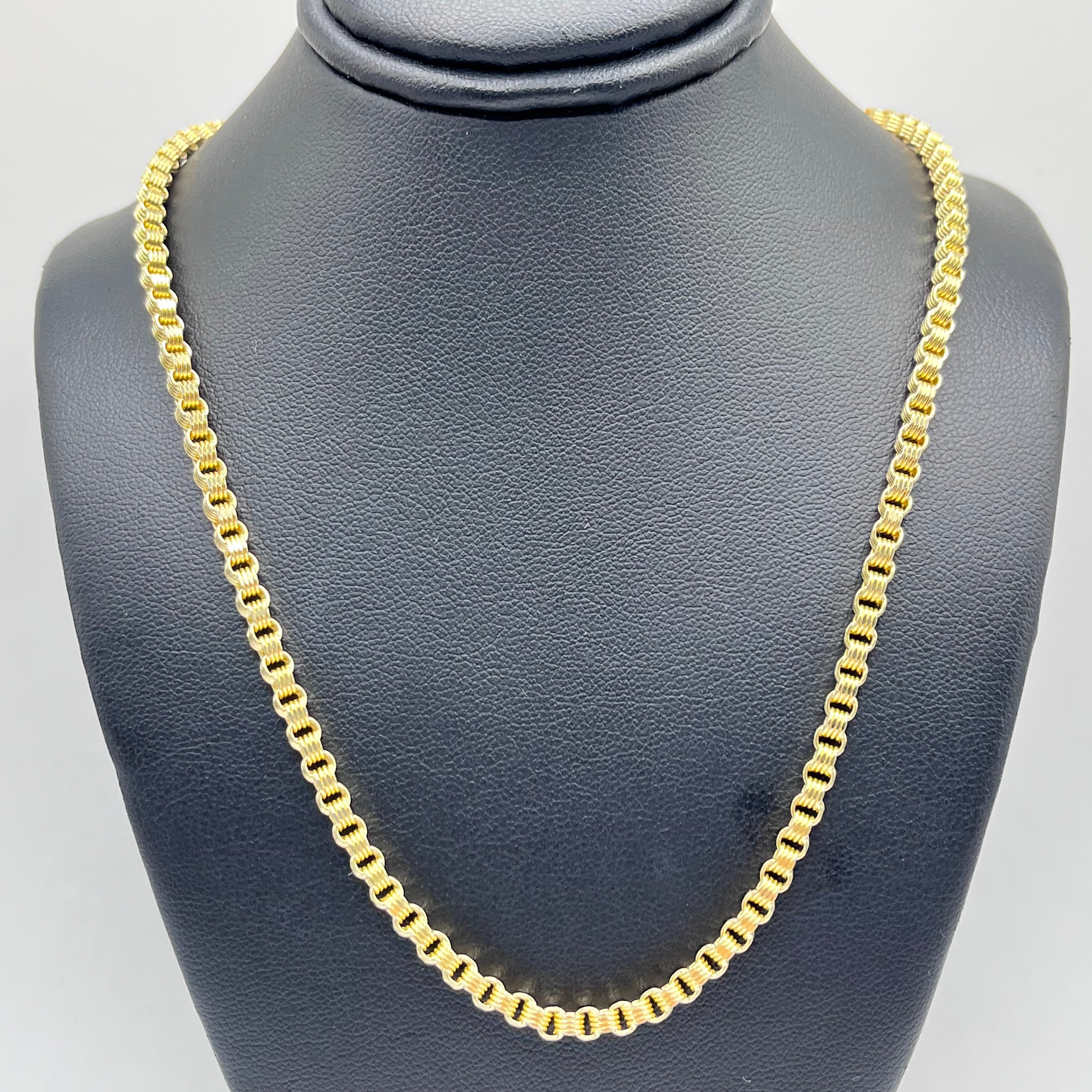
A Byzantine chain uses repeating groups of interlocking rings folded into one another.
The result is a dense, three-dimensional weave that has plenty of detail even without a pendant.
Omega and Snake Chains
Omega and Snake chains can look similar from a distance because both create a smooth surface with little open space.
An Omega chain uses small metal plates arranged over an underlying core.
A Snake chain uses tightly connected curved plates to create a smooth tubular line.
Both should be protected from sharp bends.
Milano Chains
A Milano chain gives shoppers another option when they want texture without the spiral of a Rope.
Candy Jewelers' Milano chain collection uses flattened textured links that create a wider reflective face while sitting relatively close to the body.
Turkish Link Chains
A Turkish link chain is about intricate pattern and depth.
Candy Jewelers' Turkish link chains use a complex woven surface that looks different from the more familiar Rope, Cuban or Franco.
The name is not perfectly standardized across every maker, so the actual link construction is more useful than the label alone.
Popcorn and Satellite Chains
A Popcorn chain uses shaped hollow links to create a rounded, textured surface with noticeable volume.
A Satellite chain places small beads or accents at intervals along a finer chain.
Popcorn is about texture. Satellite is more about spacing and layering detail.
Alexander Chains
The Alexander chain is another specialty style in the Candy Jewelers lineup.
Its woven, geometric structure creates more visible depth than a basic flat chain.
The current Alexander chain collection includes several widths, allowing the same pattern to move from more restrained to statement-driven.
Which Chain Styles Do Men Tend to Wear, and Which Do Women?
Gold chains are not inherently men's or women's jewelry.
The same link can look completely different depending on width, length, finish and how it is styled.
That matters when searching for mens gold chain styles, because the style name alone does not tell you whether a chain will read bold, minimal or somewhere in between.
Styles Commonly Seen in Men's Jewelry
Men's styling has traditionally leaned toward wider links and chain patterns with a strong visual profile.
Common choices include Cuban, Miami Cuban, Franco, Rope, Figaro and RX.
Longer lengths also create more space below the neckline and can make room for larger pendants.

Styles Commonly Seen in Women's Jewelry
Women's styling often covers a wider range of widths and combinations.
Finer Rope, Figaro, Valentino and Herringbone chains can create a clean solo look or become part of a layered setup.
That does not mean women need to stay with narrower chains. A wide Cuban, Miami Cuban or RX can work just as well when the necklace is supposed to carry the look.
Width and proportion matter more than the gender label.
Which Chain Styles Work for Anyone?
Most gold chain styles can work for anyone.
Rope, Cuban, Franco, Figaro and RX all cross easily between men's and women's styling.
The difference comes down to scale.
A fine Rope adds texture without dominating the neckline. A wider Rope becomes the main piece.
A narrower Cuban can share space with other chains. A wide Miami Cuban wants much more attention.
A slim Franco works naturally with pendants, while a wider Franco lets more of the V-shaped weave show.
Instead of asking whether a chain is "for men" or "for women," ask what you want it to do.
Want something subtle? Go narrower.
Want the chain itself to get noticed? Add width.
Want a pendant to lead? Choose enough chain to balance it without competing with it.
Want to layer? Mix textures and give each chain room to show.


Why Do Two Chains the Same Length Cost Very Different Amounts?
Two chains can both measure 22 inches and still have very different prices.
The main reasons are gram weight, width, gold content, construction, link design and finishing.
Gram Weight
Gram weight tells you how much material is actually in the piece.
A wider or denser chain generally uses more gold than a finer chain of the same length.
Width and Link Design
A 6mm Miami Cuban is constructed very differently from a 6mm Herringbone or hollow Rope.
The width number may match, but the amount and distribution of metal do not.
Hollow vs. Solid Construction
Hollow construction uses less metal inside the links. That can create a larger-looking chain at a lighter weight and lower price.
A comparable solid-construction chain contains more gold and will generally weigh and cost more.
Gold Content
The amount of pure gold in the alloy also affects material value and color.
Finishing and Detail
Diamond cutting, intricate link patterns and more complex closures can add manufacturing steps.
Quick answer: Two chains of the same length can cost very different amounts because length does not tell you how much gold is in the piece.

Solid or Hollow: How Construction Changes Weight, Price and Durability
Chain style tells you what the necklace looks like. Construction tells you how much metal is inside it.
That distinction matters because a hollow Rope and a solid-construction Rope can have similar outside dimensions while feeling completely different in the hand.
The key point is simple:
Hollow gold can still be real gold.
The Federal Trade Commission's gold-jewelry guidance separates hollow construction from plated, filled and other surface-layer products. In FTC terminology, calling a gold item "solid" means it is not hollow.
Why Choose a Hollow Gold Chain?
Hollow construction lets a jeweler create more visible size while using less gold inside the links.
That gives shoppers two clear advantages: less weight on the neck and a more accessible price than a comparable solid-construction chain.
The tradeoff is care. Hollow chains should be protected from crushing, hard pressure and strong snags.
Why Choose Solid Construction?
Solid construction uses more gold throughout the links.
At a comparable size, that generally means more gram weight, a heavier feel and a higher price.
Some shoppers want that weight. Others choose it because they expect more demanding wear or plan to pair the chain with a heavier pendant.
Neither option makes the other unnecessary. They solve different problems.
How Karat Changes Gold Content and Color
Candy Jewelers works with 10K and 14K real gold.
Karat describes how much of a 24-part alloy is gold. A higher-karat alloy contains a greater percentage of pure gold.
GIA explains that gold alloys affect both color and physical properties. That is why it is too simple to say a lower-karat chain is automatically stronger. Alloy composition matters too.
For many shoppers, the most visible differences are color and price. Higher gold content generally produces a richer yellow tone and carries more gold value, while lower gold content can make a real gold chain more accessible.
Candy Jewelers also carries higher-gold-content chain options for shoppers who prefer that look.
Hollow Gold Is Not the Same as Gold-Plated
A hollow real-gold chain uses gold alloy throughout the metal that forms the links, with open space inside the construction.
Plated, filled and vermeil jewelry use gold over another material.
So the useful question is not whether hollow is "real." It is which construction fits your budget, desired width, preferred weight and daily routine.

Which Chain Styles Are Trending Right Now?
The broader 2026 jewelry direction is leaning toward pieces with more presence and more intentional styling.
British Vogue's 2026 necklace coverage highlights chunky necklaces as part of the year's maximalist side, while finer chains, pendants and layered looks still remain in the mix.
That makes several directions especially relevant for gold chains.
Strong Solo Chains
A wider Miami Cuban, RX, Franco or Rope can carry the neckline without much help.
The exact style changes the effect.
Miami Cuban gives you dense rounded links. RX brings a structured watch-band profile. Franco creates a tighter woven look. Rope adds more texture.
More Intentional Layering
Layering is not gone. It simply works better when every chain has a role.
Pair a flatter link with a textured Rope. Stagger the lengths. If one chain carries a pendant, give it enough space to become the focal point.
The goal is contrast, not quantity.
Flat Gold Statements
Herringbone, Valentino, Mariner, and flat Cuban chains also fit the current interest in noticeable necklaces.
They create surface area without relying on oversized round links.
Personalized Pendants
Picture pendants, initials, religious pieces and custom nameplates give the chain a clear personal focal point.
The better trend question is not just "What chain is popular?"
It is which current look already fits the way you dress?
Which Chains Hold a Pendant Best?
Rope, Franco and Cuban-style chains are strong starting points for many pendants because they have enough visual presence to balance the piece hanging from them.
The exact match still depends on pendant size, weight, bail opening, chain width and construction.
Match the Pendant to the Chain Width
A small charm usually looks cleaner on a finer chain.
A large picture pendant, cross or nameplate needs more visual support. If the chain is too fine, the pendant may look oversized even when the chain can physically carry it.
The goal is balance, not maximum width.

Check the Bail Opening
The bail is the loop at the top of a pendant that the chain passes through.
Make sure the opening fits the chain and, if necessary, the widest part of the clasp or end hardware.
There is no need for a fixed percentage formula. Measure the actual pieces.
Franco, Rope and Cuban-style chains are all useful starting points.
Franco gives a picture pendant a structured base. Rope adds texture around the frame. Cuban gives you a flatter backdrop.
The larger the pendant, the more important proportion becomes.
What About Nameplates?
A horizontal piece such as a custom gold nameplate should sit on a chain that supports its shape without overwhelming the lettering.
A finer or medium-width Rope, Franco or Cuban can all work depending on the nameplate.
Which Chains Are Better Without Pendants?
Herringbone is generally better on its own because the flat surface is the main feature.
Wide RX chains also tend to look cleaner solo.
Large Miami Cubans often fall into the same category once the links become wide enough.
If the pendant is the reason you are wearing the necklace, choose a chain that supports it. If the chain already carries the whole look, leaving it alone can be the better call.
How Do You Choose a Chain Width and Length?
The same chain can look completely different depending on its width and length.
A shorter chain stays closer to the neckline. Add inches and it drops lower. Width changes the effect just as much.
The right size depends on your frame, neck size, chain style, pendant and the look you want.

Choosing Chain Width in Millimeters
|
Chain Width |
General Look |
Often Works Well For |
|
Under 2mm |
Fine and minimal |
Small pendants, subtle layers |
|
2mm to 3mm |
Noticeable without taking over |
Everyday wear, pendants, layering |
|
4mm to 6mm |
More prominent |
Solo wear, larger pendants, anchor layers |
|
7mm and wider |
Statement scale |
Chains designed to lead the look |
These are visual ranges, not rules.
A 4mm Herringbone spreads its width across a flat surface. A 4mm Rope is rounded. A 4mm Franco is more compact.
Choosing Chain Length in Inches
Jewelers of America groups necklace lengths into broad placement ranges, but your body proportions still matter.
A 20-inch chain will not land in the exact same place on everyone.
Neck circumference, height, shoulders, body shape, chain profile and pendant weight all affect the final position.

|
Length |
General Effect |
|
16 inches |
Close to the base of the neck on many people |
|
18 inches |
Short everyday placement |
|
20 inches |
More room below the neckline |
|
22 inches |
Lower drop and more layer separation |
|
24 inches |
Longer placement with room for many pendants |
|
26 inches and longer |
Extended statement look |
Measure Before You Order
Use a piece of string or a flexible measuring tape to preview different chain lengths at home, but make sure your measuring method is reasonably close to the width of the chain you plan to buy.
A thin string will not sit on your neck the same way a wide 10mm RX or Herringbone chain will. Wider and flatter chains take up more surface area, which can affect where they sit and how long they appear once worn.
Try more than one length. Compare 18 inches with 20, then 20 with 22 or 24.
Also keep the chain style in mind. Flatter chains such as Herringbone can sit a little higher and wear shorter than a rounded or more flexible link style. For example, a 22-inch Herringbone may sit on the chest similarly to a shorter Franco because of the way each chain lays on the body.
If you plan to add a pendant, include the pendant’s extra drop when judging the final placement.
Clothing matters too. A chain you want to wear over a hoodie may need a different length from one meant to sit above a lower neckline.
The best approach is to preview the length, width and chain profile together, not the length by itself.
Choosing Lengths for Layering
A clean stack needs separation.
If two chains sit at almost the same point, they can overlap and hide each other's link patterns.
Mix lengths, textures and widths instead.
A flatter Cuban paired with a Rope creates more contrast than two chains with nearly identical surfaces.
Which Chain Styles Hold Up to Everyday Wear?
If you are looking for which gold chain is most durable, the most accurate answer is not one chain name.
Everyday durability depends on link design, width, gram weight, hollow or solid construction, clasp and how the chain is worn.
Styles Commonly Chosen for Frequent Wear
Franco and substantial Cuban or curb-style chains are common choices for frequent wear because their link structures are compact and relatively straightforward.
Jewelers of America also describes Cuban and curb chains as practical everyday styles, while noting that repairability depends on construction and link size.
What About Rope Chains?
Rope chains deserve a more careful answer.
Their twisted construction gives them movement and texture, but Rope should not be described as the universal strongest chain.
A fine or hollow Rope should not be expected to handle the same pressure as a much heavier chain simply because both share the Rope name.
Which Styles Need More Care?
Herringbone, Snake and Omega-style chains depend on a smooth controlled profile.
Sharp bends can be much more noticeable than they would be on open-link chains.
Can You Sleep in a Gold Chain?
You can, but whether you should depends on the style.
Sleeping adds hours of pressure, twisting and contact with bedding.
Flat chains and hollow chains benefit from being removed rather than trapped underneath the body overnight.
Should You Work Out in a Gold Chain?
Removing fine jewelry before hard workouts, contact sports or physical work is the safer move.
Chains can catch on equipment, clothing or the body under pressure.
How Hollow Construction Changes Everyday Wear
Hollow construction gives you more visible size with less gram weight.
The practical difference is pressure.
Avoid crushing a hollow chain, pulling it hard or storing it underneath heavier pieces.
When Should a Chain Be Checked?
If a clasp feels loose, a link looks stretched, a hollow section becomes dented or a flat chain begins to crease, have it looked at before wearing it again.
A chain carrying an important pendant deserves even more attention because the clasp and links are what keep that piece around your neck.
So, which gold chain is most durable?
There is no universal winner. Franco and substantial Cuban or curb-style chains are good places to look for frequent wear, while flat styles require different care and hollow construction should be protected from hard pressure.

The Difference Between Real Gold and Gold-Plated Jewelry
Types of Gold Chains: Questions Shoppers Ask Most
Latest Blogs From Candy Jewelers
Our jewelry blog keeps it real, just like our gold. Everything you need to know about gold jewelry is just a click away.
-

Types of Gold Chains: Complete Chain Style Guide
Types of Gold Chains: A Complete Guide to Every Chain Style A gold chain can change the whole look before you add a pendant, watch or another piece of jewelry....
Types of Gold Chains: Complete Chain Style Guide
Types of Gold Chains: A Complete Guide to Every Chain Style A gold chain can change the whole look before you add a pendant, watch or another piece of jewelry....


